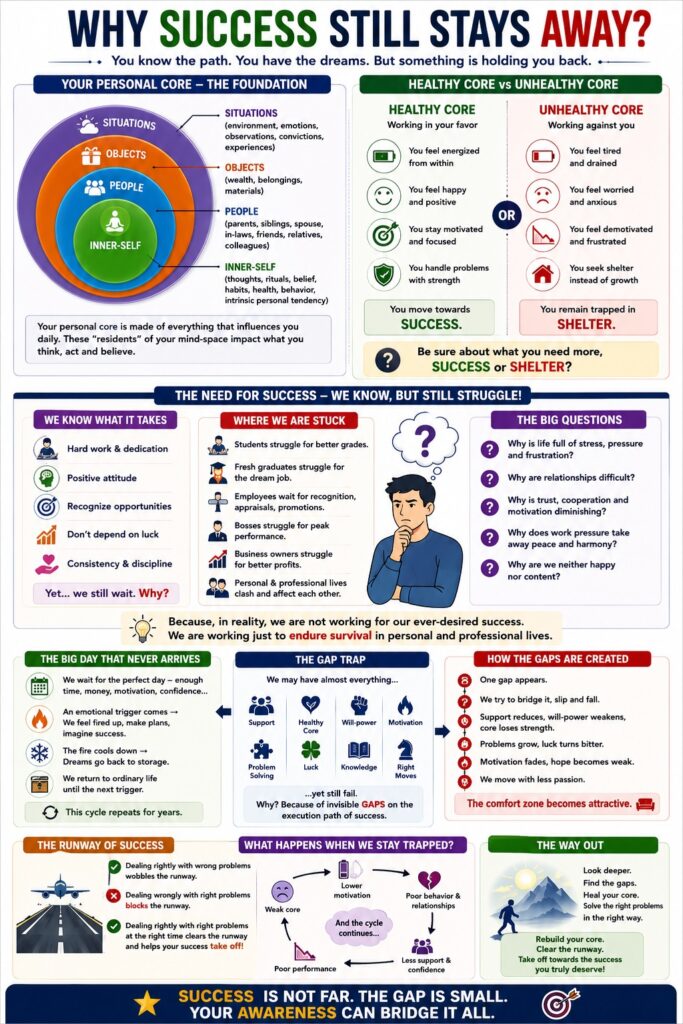

The Gap Trap: Why We Know What to Do—Yet Still Don’t Do It
If you look closely at your personal core, you will discover something fascinating.
It is not built from one single thing.
It is a living collection of everything that touches your life every day—people, experiences, beliefs, habits, emotions, thoughts, relationships, successes, failures, hopes, fears and even the situations you repeatedly expose yourself to.
These things become permanent residents of your mind space.
They follow you into a crowded room.
They follow you when you are alone.
They quietly influence what you think, what you believe, how you feel, and ultimately, how you behave.
When these elements work in your favour, something inside you feels alive. You feel energetic. You feel hopeful. You feel motivated. Even difficult situations appear manageable.
But when these same elements begin working against you—even unintentionally—the story changes.
You feel tired without knowing why.
You worry more than you act.
You lose motivation.
You become defensive.
And slowly, you begin seeking shelter instead of success.
So perhaps the first question we need to ask ourselves is surprisingly simple:
What do I really need more—success or shelter?
The Need for Success
Most of us know how dreams are supposed to come true.
We know about hard work.
We know about discipline.
We know about persistence.
We know that opportunities need to be recognized and acted upon.
We know that a positive attitude helps. We know that dedication matters.
Then why are so many of us still waiting?
Why is a student still struggling for better grades?
Why is a highly qualified graduate still waiting for the dream job?
Why does an employee remain anxious about recognition, appraisal or promotion?
Why does a leader struggle to bring out the best performance from the people around them?
Why does a business owner keep fighting for better profits?
And perhaps more importantly—
Why do our professional lives sometimes damage our personal lives?
Why do relationships become difficult?
Why does trust diminish?
Why do cooperation and emotional support become harder to find?
Why do stress, pressure and frustration occupy more space in everyday life than peace and harmony?
The answer may be uncomfortable.
Perhaps we are not really working for success.
Perhaps we are working primarily for survival.
We survive the job.
We survive the responsibilities.
We survive the pressure.
We survive the relationships.
We survive the month.
And somewhere along the way, we tell ourselves that this is simply how life is supposed to be.
There is nothing wrong with an ordinary life if we are genuinely happy with it.
But what happens when we are neither happy nor content?
That is where the conflict begins.
We want something more.
We imagine a better life.
We dream about extraordinary success.
Yet the success we desire remains somewhere in the distance—always anticipated, rarely experienced.
The “Big Day” That Never Arrives
Perhaps one of the biggest traps of human ambition is the belief that there will eventually be a perfect day.
The day when everything will change.
The day when we will finally have enough time.
Enough money.
Enough motivation.
Enough confidence.
Enough support.
Enough clarity.
And then, finally, we will chase the dream.
So we place our dreams in the backyard of our minds and label them:
“Someday.”
Sometimes an emotional incident suddenly brings the dream back.
We feel ignored.
Undervalued.
Disrespected.
Rejected.
Or simply tired of being ordinary.
Suddenly, the desire for a big success becomes intense.
We tell ourselves:
“Enough is enough. I am going to change my life.”
For a few hours—or perhaps a few days—we feel unstoppable.
We make plans.
We imagine the future.
We see ourselves succeeding.
But the emotional fire eventually cools.
The mind returns to its familiar state.
The dream goes back into storage.
And we return to ordinary life.
Until the next emotional trigger arrives.
This cycle can repeat for years.
We carry great dreams and even greater plans, yet somehow fail to produce the results we imagined.
Why?
The Problem Is Not Always Motivation
We often blame the obvious things.
“I don’t have enough motivation.”
“I don’t have enough support.”
“My circumstances are against me.”
“Luck isn’t on my side.”
And sometimes these things may genuinely matter.
But there is another possibility—one that is far more uncomfortable.
Perhaps we simply haven’t learned to deal effectively with the problems that appear in everyday life.
And strangely enough, this obvious reason is often overlooked.
Problems don’t remain the same.
They grow.
They multiply.
One unresolved problem creates another.
One emotional reaction creates another conflict.
One poor decision creates another obstacle.
And gradually, the road toward success becomes crowded with hurdles.
Think of success as a runway.
You may have the right aircraft.
You may have fuel.
You may have a skilled pilot.
You may even have favourable weather.
But if the runway is blocked, the aircraft cannot take off.
That is why:
“Dealing rightly with the wrong problems wobbles the runway of success, dealing wrongly with right problems completely blocks it.
Dealing rightly with right problems at right time clears the runway to take off your success plane.”
— SKV
The real challenge, therefore, may not always be how hard we work.
It may be whether we are working on the right problem, in the right way, at the right time.
The Invisible Gaps
Success rarely fails because of one giant mistake.
More often, it leaks through small gaps.
We may have motivation—but not enough emotional stability.
We may have will-power—but insufficient support.
We may have support—but poor problem-solving.
We may have a healthy personal core—but make the wrong moves.
We may make the right moves—but fail to execute consistently.
One gap appears.
We try to bridge it.
We slip.
We fall.
We rebuild.
We climb again.
We fall again.
And slowly, something begins to change inside us.
The support we once had begins to disappear.
Our will-power becomes weaker.
Our personal core loses strength.
Problems seem larger.
Luck begins to feel bitter.
The enthusiasm that once pushed us forward becomes strangely difficult to recover.
And then comes the most dangerous part.
We don’t stop moving completely.
We simply move with less passion.
We begin believing more in difficulties and less in possibilities.
Our expectations shrink.
Our performance begins to leak.
Our dreams become less ambitious.
Our comfort zone becomes more attractive.
And without realizing it, we start protecting ourselves from failure rather than pursuing success.
The Unknown That Pulls Us Back
There is something particularly intriguing about this process.
We can often see the symptoms.
We know we are losing motivation.
We know we are becoming frustrated.
We know our performance isn’t what it used to be.
We know we are avoiding risks.
We know we are settling.
Yet we may still fail to recognize what is actually pulling us backward.
Something unknown seems to consume our energy.
Something unknown reduces our enthusiasm.
Something unknown makes the dream appear increasingly distant.
Something unknown keeps whispering:
“Stay where you are. At least this is safe.”
And this is where the cycle becomes dangerous.
Unhappiness begins influencing our personality.
Our personality begins influencing our behaviour.
Our behaviour begins disturbing our personal core.
A weakened personal core makes us even weaker.
And weakness creates frustration.
Frustration strengthens the negative behavioural loop.
Eventually, we begin seeing the world differently.
The bright canvas of possibilities becomes difficult to notice.
The dark spots become easier to see.
And perhaps even more dangerously, those dark spots begin to feel comfortable.
Why?
Because difficulties can provide us with a shelter.
Under the shelter of circumstances, bad luck, other people and adversity, we can explain away our failures.
We no longer have to confront the uncomfortable question:
“What am I missing within myself?”
The Gap Trap
This is where the idea of the Gap Trap becomes powerful.
We may have almost everything that success appears to require:
Support
A healthy personal core
Will-power
Motivation
Problem-solving ability
Good fortune
Knowledge
Opportunities
The ability to make the right moves
And still, the desired result may remain out of reach.
Not because we lack everything.
But because something between what we possess and what we execute is breaking down.
That invisible distance is the gap.
And when the gaps multiply, they create a trap.
The trap slowly weakens the personal core.
The weakened core reduces motivation.
Reduced motivation affects behaviour.
Behaviour affects relationships.
Relationships affect support.
Reduced support affects confidence.
Confidence affects performance.
And declining performance pushes us further toward the comfort zone.
A circle begins to form.
And the longer we remain inside it, the harder it becomes to recognize the exit.
Perhaps the most important question is not:
“Why haven’t I succeeded yet?”
Perhaps the more powerful question is:
“What gaps are silently preventing me from succeeding?”
Where does my energy disappear?
Where does my motivation break?
Where does my confidence weaken?
Where does my behaviour change?
Where do my relationships begin to suffer?
Where does my personal core stop supporting me?
And most importantly—
What is the “unknown” that keeps pulling me back toward mediocrity?
Because until we discover the gap, we may keep working harder…
without necessarily moving forward.
The next revolution may not require us to work harder.
It may require us to look deeper.
Here is the visual summary