
This chapter as a soulful, reflective continuation of “The Unknown”—explanation of the brain and more like a journey into the invisible forces that quietly govern human life.
THE REASON
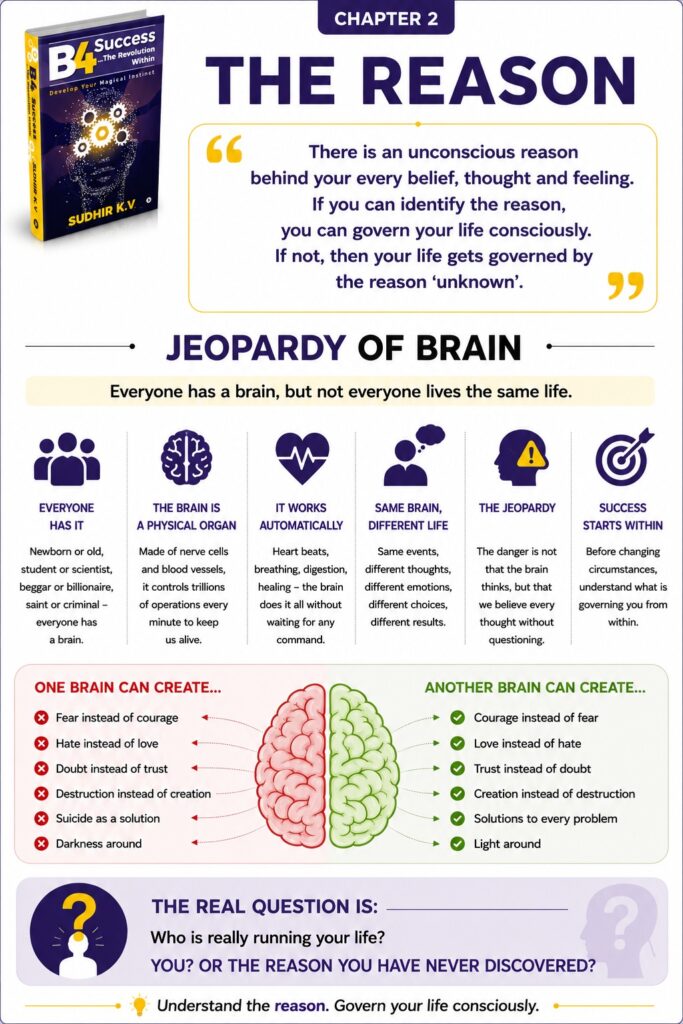
“There is an unconscious reason
behind your every belief, thought and feeling.
If you can identify the reason,
you can govern your life consciously.
If not, then your life gets governed by
the reason ‘unknown’.”
There are moments in life when we ask ourselves a simple question:
“Why did I do that?”
Why did I lose my temper?
Why did I trust that person?
Why did I fear something that had never actually happened?
Why did I choose one career over another?
Why do I love one person and dislike another?
Why does criticism hurt me so deeply?
Why does success excite me while failure breaks me?
And sometimes, the most uncomfortable question of all:
Why do I keep repeating the same mistakes even after knowing they are mistakes?
We often answer these questions with convenient explanations.
“That is just how I am.”
“My circumstances made me this way.”
“People around me are responsible.”
“I had no choice.”
“It was just a bad day.”
Perhaps.
But perhaps there is something deeper.
Something operating silently beneath the surface.
Something that makes us believe before we understand, react before we think, fear before danger arrives, love before logic approves, and sometimes destroy what we desperately wanted to protect.
That invisible force is what I call the Reason.
Not the reason we tell others.
Not even necessarily the reason we tell ourselves.
The deeper reason.
The one that operates quietly within us.
And to understand that reason, we must first enter the most fascinating territory known to humanity:
the human brain.
JEOPARDY OF THE BRAIN
We are often told that the brain is the key to success.
“Use your brain.”
“Think intelligently.”
“Train your brain.”
“Have a positive mindset.”
And there is truth in all of it.
But there is a fascinating contradiction hiding underneath.
Almost every human being has a brain.
The newborn has one.
The teenager has one.
The old person has one.
The student has one.
The scientist has one.
The beggar has one.
The billionaire has one.
The saint has one.
The criminal has one.
The optimist has one.
The pessimist has one.
The cheerful person has one.
The deeply unhappy person has one.
The lover has one.
The hater has one.
The person who creates a beautiful invention has one.
And the person who destroys something beautiful also has one.
The person who succeeds repeatedly has a brain.
And the person who repeatedly fails has a brain too.
So, if possessing a brain were enough to guarantee success…
why aren’t we all successful?
That question deserves more attention than we usually give it.
Because perhaps the problem isn’t whether we have a brain.
Perhaps the real question is:
What is happening inside the brain?
The brain is an extraordinary physical organ.
Billions of nerve cells communicate through extraordinarily complex networks. It receives information from the world, processes signals, coordinates movement, regulates countless bodily functions and participates in everything from memory and imagination to emotion and decision-making.
Much of what it does happens without our conscious permission.
Your heart beats while you are reading this.
You breathe without calculating every breath.
Your body regulates temperature.
Your digestive system continues its work.
Your immune system responds to threats.
Your eyes adjust to changing light.
You don’t sit down every morning and issue instructions to your body:
“Heart, please beat.”
“Lungs, please breathe.”
“Digestive system, please begin your work.”
The machinery simply operates.
And that is where the mystery begins.
Because the brain does not merely keep the body alive.
It also creates something far more complicated:
your experience of life.
It influences what you notice.
What you remember.
What you fear.
What you desire.
What you reject.
What you believe.
What you expect.
And, ultimately, how you interpret the world around you.
Two people can stand in exactly the same room and walk away with completely different experiences.
One sees an opportunity.
The other sees a threat.
One hears advice.
The other hears criticism.
One sees failure as a lesson.
The other sees failure as humiliation.
One person loses a job and thinks,
“This could be the beginning of something new.”
Another loses the same job and thinks,
“My life is over.”
The event is the same.
The interpretation is different.
And somewhere between the event and the interpretation lies a world we rarely examine.
THE SAME BRAIN, DIFFERENT WORLDS
Imagine two people looking at the same ocean.
One sees freedom.
Another sees danger.
One sees beauty.
Another remembers a tragedy.
One hears the sound of waves and feels peaceful.
Another hears the same waves and feels anxious.
Did the ocean change?
No.
The observer changed.
And that is one of the great mysteries of human existence.
We don’t experience reality exactly as it is.
We experience reality through the filters we have developed.
Our memories.
Our experiences.
Our conditioning.
Our expectations.
Our fears.
Our beliefs.
Our desires.
Our disappointments.
Our relationships.
Our successes.
Our failures.
And beneath all of these, perhaps, lies something even more fundamental:
the reason.
The reason behind why one experience becomes a wound in one person and wisdom in another.
The reason why one person responds to criticism with anger while another responds with curiosity.
The reason why one person sees rejection as the end of the road while another sees it as a redirection.
The reason why one person, trapped inside darkness, searches desperately for a way out…
while another, standing in almost the same darkness, discovers a small ray of light.
THEN WHY DOES ONE MIND BUILD WHILE ANOTHER DESTROYS?
This is where the mystery becomes profound.
Why does one human mind generate extraordinary creativity, compassion, courage and innovation?
Why does another generate hatred, jealousy, violence or despair?
Why can one person look at an impossible problem and say,
“There must be a solution.”
while another looks at the same problem and concludes,
“There is no solution.”
Why can one person experience failure and become stronger?
Why can another experience failure and become broken?
Why can one person lose everything and still choose life?
And why can another, surrounded by wealth, comfort and apparent success, feel that life itself has become unbearable?
These questions take us back to Rohan.
He had a house.
A career.
A position.
A family.
Financial resources.
Social status.
And yet, somewhere inside him, life had become unbearable.
The world looking at Rohan might have asked:
“What does this man have to be unhappy about?”
But the deeper question was entirely different:
“What was happening inside him that made what he had feel insufficient?”
That is a very different question.
And perhaps it is the question we should ask ourselves more often.
THE JEOPARDY
The greatest danger of the human brain may not be that it can think.
It may be that it can believe its own thoughts.
A thought appears.
We accept it.
A feeling arises.
We identify with it.
A fear emerges.
We treat it as a fact.
A memory returns.
We allow it to define the present.
A person disappoints us once.
We decide that everyone is untrustworthy.
One failure occurs.
We conclude that we are failures.
One relationship ends.
We conclude that love itself is painful.
One rejection happens.
We begin believing that we are not worthy.
And slowly, without realizing it, a thought becomes a belief.
A belief becomes a pattern.
A pattern becomes behaviour.
Behaviour becomes habit.
And habit begins shaping a life.
That is the jeopardy.
Not that the brain thinks.
But that we may stop questioning what the brain is telling us.
Perhaps, then, the real battle for success is not fought outside us.
It is fought in the invisible territory between:
what happens to us
and
what we make it mean.
That tiny space can change an entire life.
A criticism can become an insult.
Or an opportunity to grow.
A failure can become a defeat.
Or an education.
A rejection can become humiliation.
Or direction.
A crisis can become the end.
Or the beginning.
The external event may remain exactly the same.
But the internal meaning can transform everything.
And that brings us back to the question from the previous chapter.
What is that “unknown thing” within us?
What silently pushes one person toward darkness and another toward light?
What makes success so desirable?
What makes failure so disturbing?
What makes us love?
What makes us hate?
What makes us trust?
What makes us doubt?
What makes us surrender?
And what makes us rise again when everything around us says,
“Stay down.”
Maybe the answer is not somewhere outside us.
Maybe it is operating quietly within us every moment.
Invisible.
Powerful.
Uninvited.
And often unnoticed.
We spend years trying to change our circumstances.
We change jobs.
Cities.
Relationships.
Friends.
Companies.
Possessions.
Even countries.
Yet sometimes we carry the same suffering with us wherever we go.
Because perhaps the thing we desperately need to change is not where we are.
Perhaps it is what is governing us from within.
And if that is true, then there is one question we can no longer avoid:
Who is really running your life?
You?
Or the reason you have never discovered?
That question opens the door to the next part of our journey.
Because before we can govern our lives consciously, we must first understand the invisible machinery that has been governing us unconsciously.
And that journey begins…
within.