THE BEHAVIORAL LOOP
How one emotion can quietly change the direction of your life
Have you ever noticed how one bad moment can spoil an entire day?
Someone speaks harshly to you in the morning.
You feel hurt.
That hurt changes your mood.
Your mood changes the way you look at everything around you.
A small inconvenience suddenly feels irritating.
Someone asks you a simple question, but you respond sharply.
They react to your behaviour.
Now you feel even more misunderstood.
And before you realize it, a single unpleasant moment has created an entire chain of unpleasant experiences.
It began with something small.
But somewhere along the way, emotion became perception, perception became behaviour, and behaviour created another emotion.
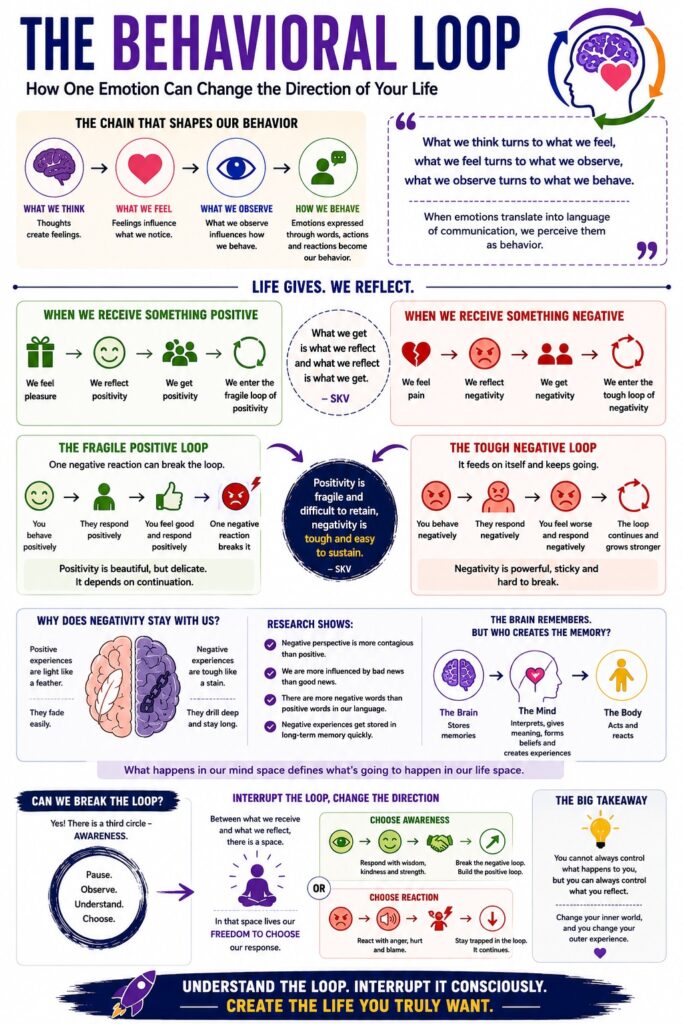
This is what we can call the Behavioral Loop.
FROM THOUGHT TO BEHAVIOUR
Our inner world does not remain locked inside our minds.
It travels.
A thought creates a feeling.
A feeling influences what we notice.
What we notice influences how we behave.
And when our emotions are expressed through words, gestures, reactions and actions, other people experience those emotions as our behaviour.
The chain looks simple:
What we think → what we feel → what we observe → how we behave.
But the consequences can be enormous.
Imagine that someone sends you a message and doesn’t reply to your question.
One person may think:
“Perhaps they are busy.”
Another may think:
“They are deliberately ignoring me.”
The event is identical.
But the thought is different.
And because the thought is different, the feeling becomes different.
One person remains calm.
The other becomes hurt.
And once hurt enters the picture, behaviour can change.
A cold reply.
A sarcastic comment.
Silence.
Anger.
Withdrawal.
The other person reacts to that behaviour.
And suddenly, something that began with an unanswered message has become an emotional conflict.
That is the power of the loop.
LIFE DOESN’T ALWAYS GIVE US WHAT WE EXPECT
Life has a peculiar habit of surprising us.
Sometimes we receive something wonderful when we were expecting nothing.
At other times, something goes terribly wrong just when everything seemed to be going perfectly.
We succeed.
We receive appreciation.
Someone congratulates us.
We feel proud.
Our behaviour naturally becomes pleasant.
We smile.
We share.
We encourage.
We become generous.
But when something goes wrong, something different often happens.
We fail.
We are criticized.
We lose an opportunity.
Someone disappoints us.
And suddenly we search for something—or someone—to blame.
“It was because of the circumstances.”
“They didn’t support me.”
“I was unlucky.”
“If that hadn’t happened, I would have succeeded.”
There is nothing unusual about this human reaction.
But hidden inside it is a fascinating pattern.
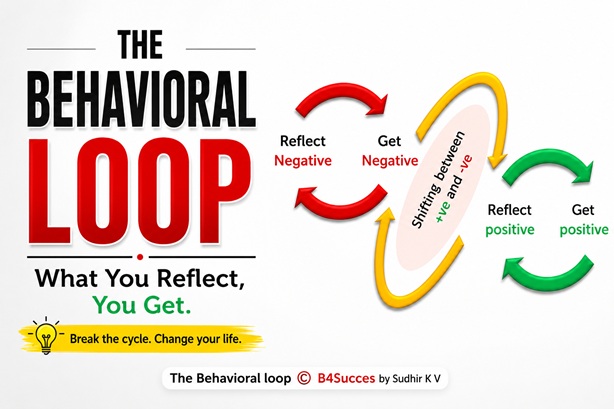
When we receive something positive, we tend to reflect positivity.
When we receive something negative, we tend to reflect negativity.
And that is where the loop begins.
“WHAT WE GET IS WHAT WE REFLECT…”
“What we get is what we reflect and
what we reflect is what we get”
– SKV
Think about a simple conversation.
You smile at someone.
They smile back.
You speak kindly.
They respond kindly.
You appreciate them.
They feel valued and may appreciate you in return.
Something beautiful happens.
Positive behaviour creates positive behaviour.
You receive positivity.
You reflect positivity.
You receive more positivity.
And you enter what we might call the fragile loop of positivity.
Why fragile?
Because it depends on continuation.
It only takes one unexpected negative reaction to disturb it.
THE FRAGILE POSITIVE LOOP
Imagine that you are having a wonderful day.
You are calm.
You are confident.
You speak positively with everyone around you.
Then you meet someone who is having a terrible day.
Perhaps they are frustrated.
Perhaps they are carrying anger from something that happened earlier.
Perhaps their own internal paradigm has pushed them into a negative emotional state.
You say something harmless.
They respond rudely.
Suddenly, you feel insulted.
Your emotional state changes.
You respond sharply.
They respond even more sharply.
And the beautiful positive loop is broken.
This is the strange vulnerability of positivity.
You may enter a conversation carrying peace…
and leave carrying someone else’s anger.
You may enter with a smile…
and leave with a wound.
You may begin with kindness…
and somehow end in conflict.
That is why positivity can be fragile.
THE TOUGH NEGATIVE LOOP
Now consider the opposite.
You begin with irritation.
You speak negatively.
The other person reacts negatively.
You feel attacked.
You respond more aggressively.
They respond again.
The cycle continues.
Negative behaviour produces negative behaviour.
Negative behaviour creates more negative emotion.
Negative emotion influences further negative behaviour.
And the loop becomes stronger.
This is what makes negativity so dangerous.
Once it starts moving, it can develop its own momentum.
“Positivity is fragile and difficult to retain,
negativity is tough and easy to sustain.”
– SKV
Think about an argument between two people.
At the beginning, there may be one disagreement.
Ten minutes later, they are no longer discussing the original issue.
They are discussing something that happened three years ago.
Then another accusation appears.
Then another.
Then another.
Eventually, neither person remembers exactly where the argument began.
Why?
Because the loop has taken over.
They are no longer responding only to the original event.
They are responding to each other’s responses.
WHY DOES NEGATIVITY STAY WITH US?
There is another fascinating observation in this chapter.
Positive experiences often feel light.
A compliment can make us happy.
A beautiful sunset can give us peace.
A pleasant conversation can lift our mood.
But sometimes the experience passes quickly.
A negative experience can be very different.
An insult can stay in our mind for years.
A betrayal can become a permanent reference point.
A painful rejection can influence future relationships.
A humiliating experience can become part of our identity.
Why does the mind seem to hold on so tightly to painful experiences?
The chapter describes negative experiences as something that can become deeply embedded in memory, while positive experiences may fade more easily.
It connects this with the idea of negativity bias—the tendency for negative information to exert a stronger influence on our attention, memory and attitudes than positive information.
The chapter cites research associated with Paul Rozin, Edward Royzman and John Cacioppo and describes findings suggesting that bad news and negative stimuli can exert a particularly powerful influence on the mind.
The important idea for our journey is not simply the research itself.
It is what this means for everyday life:
If negativity naturally grabs our attention more strongly, then developing a positive intrinsic tendency requires conscious effort.
THE BRAIN REMEMBERS. BUT WHO CREATES THE MEMORY?
This leads us to an even deeper question.
If the brain stores memories…
who creates those memories?
Something happens.
The brain receives information.
But the experience does not end there.
We interpret it.
We attach meaning to it.
We decide whether it was good or bad.
Important or insignificant.
Threatening or safe.
Painful or inspiring.
And somehow, an event becomes a personal experience.
Consider two people losing the same job.
One thinks:
“My career is finished.”
Another thinks:
“This is the push I needed to start something of my own.”
The event is the same.
The memory is not.
The meaning is not.
The emotional imprint is not.
So perhaps the brain is not the whole story.
ENTER THE MIND
The chapter makes a distinction between the brain and the mind.
The brain is physical.
The mind, as presented here, is the invisible psychological space through which we interpret our experiences.
The mind gives meaning to feelings.
It shapes perceptions.
It develops convictions.
It forms preferences.
It decides what feels good or bad, right or wrong, desirable or undesirable.
In this view, the mind becomes the psychological engine interacting with the brain and body.
And this gives us a profound idea:
What happens in our mind space influences what happens in our life space.
Think about it.
The world outside may remain unchanged.
But change the meaning inside your mind…
and your experience of that world can change dramatically.
THE SAME EVENT. A DIFFERENT LIFE.
Imagine two people standing in front of the same closed door.
One sees rejection.
The other sees a reason to search for another entrance.
One sees an ending.
The other sees a beginning.
One sees proof that life is against them.
The other sees an invitation to try differently.
The door hasn’t changed.
The mind looking at the door has.
This is where the behavioral loop connects with everything we have explored so far.
Your paradigm influences your thoughts.
Your thoughts influence your emotions.
Your emotions influence your perceptions.
Your perceptions influence your behaviour.
Your behaviour influences the behaviour of others.
Their behaviour becomes your next experience.
That experience enters your mind.
And the loop begins again.
Paradigm → Thought → Emotion → Perception → Behaviour → Experience → Paradigm
Round and round.
Day after day.
Sometimes for years.
THE MOST IMPORTANT QUESTION
If we are trapped inside these loops, can we ever escape them?
Can a person change the direction of the loop?
Can negativity be interrupted before it becomes behaviour?
Can an emotional reaction be paused before it becomes an irreversible decision?
Can we stop ourselves from reflecting everything that we receive?
Because if the answer is no, then we are essentially prisoners of our own emotional reactions.
Someone gives us anger.
We give anger back.
Someone gives us hurt.
We return hurt.
Someone behaves negatively.
We reflect negativity.
And the cycle continues.
But perhaps there is another possibility.
Perhaps somewhere between what we receive and what we reflect, there is a small space.
A moment.
A pause.
A conscious choice.
A place where we can say:
“I received this emotion. But I don’t have to return it.”
That could be the beginning of freedom.
THE THIRD CIRCLE
The chapter asks an intriguing question:
If positivity and negativity are both loops, then is there a third circle?
Something that allows us to move consciously from one emotional cycle to another?
Because nobody can remain permanently joyful.
And nobody needs to remain permanently unhappy.
Life will keep changing.
We will experience success and failure.
Praise and criticism.
Love and rejection.
Joy and pain.
Certainty and uncertainty.
So perhaps emotional maturity isn’t about staying permanently inside the positive loop.
Perhaps it is about developing the ability to shift loops consciously.
To recognize:
“I am becoming negative.”
“I am reacting instead of responding.”
“This emotion is beginning to control my perception.”
“I am about to return negativity simply because I received it.”
That awareness could become the interruption.
The gap in the loop.
The point at which the automatic response ends…
and conscious choice begins.
THE MIND SPACE CREATES THE LIFE SPACE
This brings us to perhaps the most important idea in this chapter.
Your life is not shaped only by what happens to you.
It is shaped by what happens inside you after something happens to you.
An event enters your life.
Your mind interprets it.
Your emotions respond.
Your behaviour follows.
Your behaviour changes the environment around you.
And that environment gives you another experience.
The cycle continues.
Therefore, the quality of your internal world matters enormously.
“What happens in our mind space defines what’s going to happen in our life space.”
And perhaps that is why the real revolution cannot begin with changing everybody else.
It must begin by observing ourselves.
Before changing the world outside…
we need to understand the world within.
Because if we don’t understand our own loops, we may spend our entire lives reacting to them.
And if we learn to recognize them, perhaps we can finally begin to choose:
what we think,
what we feel,
what we reflect,
and ultimately,
what we create.
The loop may be automatic.
But perhaps the next response doesn’t have to be.
And that is where the revolution within becomes real.
Here is the visual summary