THE BLACK SPOT — AND THE LIFE WE FAIL TO SEE
There is a strange habit hidden inside the human mind.
We notice what is wrong much faster than we notice what is right.
One criticism can stay with us for days, while a hundred compliments disappear within minutes.
One financial setback can occupy our thoughts for weeks, while countless things we already possess barely receive a moment of attention.
One difficult relationship can overshadow the love of everyone around us.
One failure can become larger in our mind than all the successes that came before it.
Why?
Perhaps the answer lies in a tiny black spot.
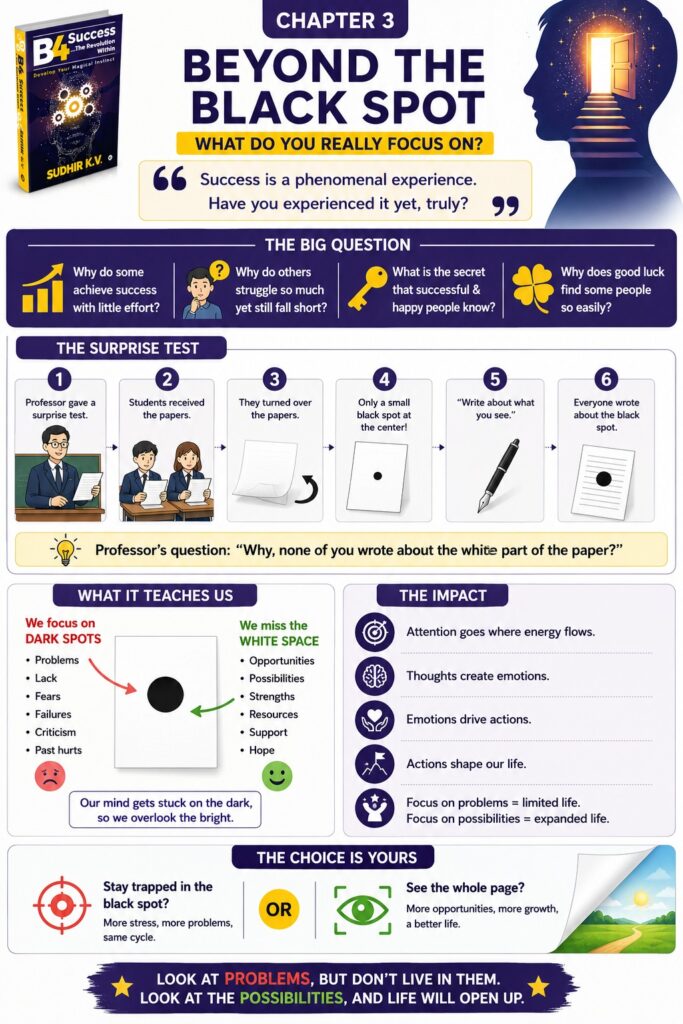
The Surprise Test
One day, Professor Manikaran decided to conduct a surprise test.
The students sat anxiously at their desks as he distributed the question papers, face down.
When everyone had received a sheet, he asked them to turn it over.
The classroom went silent.
There were no questions.
No instructions.
No problem to solve.
Only a small black spot at the centre of a completely white sheet of paper.
The students looked at one another.
What kind of test was this?
Then the professor gave them a simple instruction:
“I want you to write about what you see there on the paper.”
Confused but obedient, the students began writing.
Some described the shape.
Some described its position.
Some analysed its size.
Some used elaborate language to explain the black spot.
But every student did essentially the same thing.
They wrote about the black spot.
At the end of the class, Professor Manikaran collected the papers and read their answers aloud.
Then he surprised them.
He told them that he wasn’t going to grade the test.
He had wanted to observe something else.
And then came the question:
“Why, none of you wrote about the white part of the paper?”
The students were stunned.
They had all seen the white paper.
Their eyes had captured the entire sheet.
Yet their minds had almost completely ignored it.
Not deliberately.
Not consciously.
It simply happened.
Their attention had been captured by the black spot.
And perhaps that tiny classroom experiment tells us something enormous about the way we live.
ARE YOU LIVING INSIDE THE BLACK SPOT?
Think about your own life for a moment.
What occupies your mind most often?
The money you don’t have?
The health problem that worries you?
The relationship that isn’t working?
The criticism someone gave you?
The promotion you didn’t receive?
The business that failed?
The opportunity you missed?
The person who betrayed you?
The mistake you made years ago?
These are our black spots.
And once our attention lands on one of them, something remarkable begins to happen.
We don’t merely notice the problem.
We begin to build our world around it.
We think about it.
Analyse it.
Discuss it.
Replay it.
Judge it.
Imagine possible outcomes.
Search our memories for similar experiences.
Create stories around it.
And before we know it, one small dark spot has occupied an enormous amount of mental space.
Meanwhile, the white space remains untouched.
The opportunities.
The relationships that still work.
The abilities we still possess.
The resources available to us.
The people willing to help.
The lessons hidden inside failure.
The possibilities we haven’t explored.
The life that is still waiting to be lived.
All of it is there.
But we don’t see it.
Not because it isn’t there.
Because our attention is somewhere else.
THE MIND DOESN’T JUST SEE. IT SELECTS.
This is where the black-spot story becomes much deeper.
Your eyes may see the entire page.
But seeing is not the same as noticing.
And noticing is not the same as thinking.
The moment the mind identifies something as important, it begins directing its resources toward it.
The black spot becomes the subject.
Then the mind starts doing what it knows best.
Thinking.
It evaluates the spot.
It interprets it.
It compares it with memories.
It searches for associations.
It creates explanations.
It generates feelings.
It builds a narrative.
And suddenly, that tiny black spot has become psychologically much larger than its physical size.
The paper hasn’t changed.
The spot hasn’t changed.
Only the meaning attached to it has changed.
The mind has transformed a tiny visual detail into the centre of an entire mental universe.
Isn’t that exactly what happens in our lives?
Someone says one harsh sentence.
We replay it fifty times.
A business suffers one setback.
We begin imagining complete failure.
A relationship experiences one difficult phase.
We start questioning the entire relationship.
We make one mistake.
And suddenly our mind begins telling us:
“I always make mistakes.”
One event becomes an identity.
One failure becomes a story.
One black spot becomes the whole page.
THE MOST DANGEROUS PART
The fascinating part is that we often know we are doing it.
Somewhere inside, we know there is more to life than this problem.
We know there are other possibilities.
We know there are people who love us.
We know we have survived difficult situations before.
We know that this moment is not the entirety of our life.
Yet somehow, we cannot look away.
Why?
Because once our thinking becomes confined within the boundaries created by our own attention, our ability to explore alternatives begins to shrink.
We stop asking:
“What else is possible?”
Instead, we keep asking:
“How do I solve this problem?”
There is an enormous difference between the two questions.
The first opens the landscape.
The second keeps us standing inside the same room.
As the book puts it:
“As soon as our thought gets confined within self-created limits, we lose the power of lateral thinking.”
And that may be one of the greatest hidden dangers in our journey toward success.
WE BECOME LOYAL TO OUR PROBLEMS
Every day, life presents us with both:
problems and possibilities.
But our minds are often much quicker to detect the threats.
We notice what could go wrong.
We notice what is missing.
We notice who disappointed us.
We notice what we failed to achieve.
We notice the obstacle standing in front of us.
And then we build our plans around eliminating that obstacle.
The result?
We become so busy fighting the dark spots that we forget to look at the entire landscape.
We become loyal to our problems.
We study them.
Discuss them.
Complain about them.
Defend them.
Sometimes, strangely enough, we even begin to build our identity around them.
“I am unlucky.”
“Nobody supports me.”
“My circumstances are terrible.”
“Nothing works for me.”
“Life has always been unfair to me.”
And once such thoughts become deeply embedded, we may stop searching for possibilities altogether.
The problem isn’t merely that we have difficulties.
The problem is that the difficulties begin determining where we look.
NOW IMAGINE THE OPPOSITE
What if your first glance could change?
What if, before your mind automatically rushed toward the black spot, it could also notice the enormous white space surrounding it?
What if your attention could become equally sensitive to:
opportunities,
possibilities,
resources,
relationships,
strengths,
lessons,
ideas,
hope,
and unexplored paths?
The black spot would still exist.
The problem wouldn’t magically disappear.
The difficult person might still be difficult.
The financial challenge might still be real.
The failure might still have happened.
But something fundamental would have changed.
The problem would no longer own your entire field of vision.
You would see the problem.
But you would also see the possibilities around it.
And that changes everything.
TWO PEOPLE. TWO LIVES. SAME WORLD.
Now we can return to the question that has been following us from the beginning:
Why do some people appear to find success again and again, while others struggle endlessly despite enormous effort?
Perhaps the answer isn’t simply intelligence.
It isn’t always education.
It isn’t always money.
It isn’t even always hard work.
Sometimes, the difference may lie in something much more subtle:
where their minds naturally look first.
Some people seem to possess an internal tendency that automatically draws their attention toward possibilities.
They encounter a problem and begin searching for an opportunity.
They experience failure and begin searching for a lesson.
They face rejection and begin searching for another door.
They see uncertainty and begin searching for what can be created from it.
Their attention moves toward the white space.
Others may possess an equally powerful tendency to lock onto the dark spots.
They see the problem first.
Then another problem.
Then another.
Their thoughts become occupied with obstacles.
Their emotions follow their thoughts.
Their actions follow their emotions.
And eventually, their lives begin reflecting what their minds repeatedly focused upon.
BUT HERE IS THE REAL QUESTION
If this tendency exists within us…
Where does it come from?
Why does one person naturally search for possibilities while another naturally searches for problems?
Why does one person see a setback and think, “What can I learn?”
while another thinks,
“Why does this always happen to me?”
Why does one person instinctively see the white space?
And why does another become trapped inside the black spot?
Is it personality?
Is it upbringing?
Is it experience?
Is it memory?
Is it conditioning?
Is it something hidden deeper inside the mind?
Or is there an intrinsic personal tendency quietly influencing what we notice, what we think, what we feel and ultimately how we live?
Perhaps the black spot was never the real problem.
Perhaps the real mystery is:
Why did our mind choose to look at the black spot in the first place?
And if that choice is happening unconsciously…
can we change it?
Can we train the first glance?
Can we teach the mind to see the whole page?
Can we discover the invisible reason behind our tendency to focus on darkness—or possibility?
That question takes us one step deeper into The Revolution Within.
And that is where our next exploration begins:
WHAT IS AN “INTRINSIC PERSONAL TENDENCY”?
Here is the visual summary of chapter3
...downlaod it print it and keep it infornt of you .