THE INTRINSIC PERSONAL TENDENCY
The invisible pattern that quietly decides how you see life
In the previous chapter, we explored the black spot—how our attention can become so focused on what is wrong that we fail to see everything that is right around it.
But that raises a deeper question:
Why does one person naturally notice the possibilities while another naturally notices the problems?
Why does one person look at a difficult situation and think, “There must be a way out,” while another looks at the same situation and thinks, “There is no hope”?
The answer takes us into one of the most fascinating ideas in this journey:
The Intrinsic Personal Tendency
At the heart of every person lies a kind of psychological pattern—a paradigm that develops within us from birth onward.
It is not something we consciously sit down and design.
Nobody asks us,
“What kind of person would you like to become?”
and then hands us a form to fill out.
It develops quietly.
Day after day.
Experience after experience.
Emotion after emotion.
And eventually, this invisible paradigm begins influencing the way we see the world.
YOUR INNER PARADIGM
Think of your paradigm as an invisible pair of glasses.
You don’t normally see the glasses.
You simply see through them.
The same thing happens with our psychological paradigm.
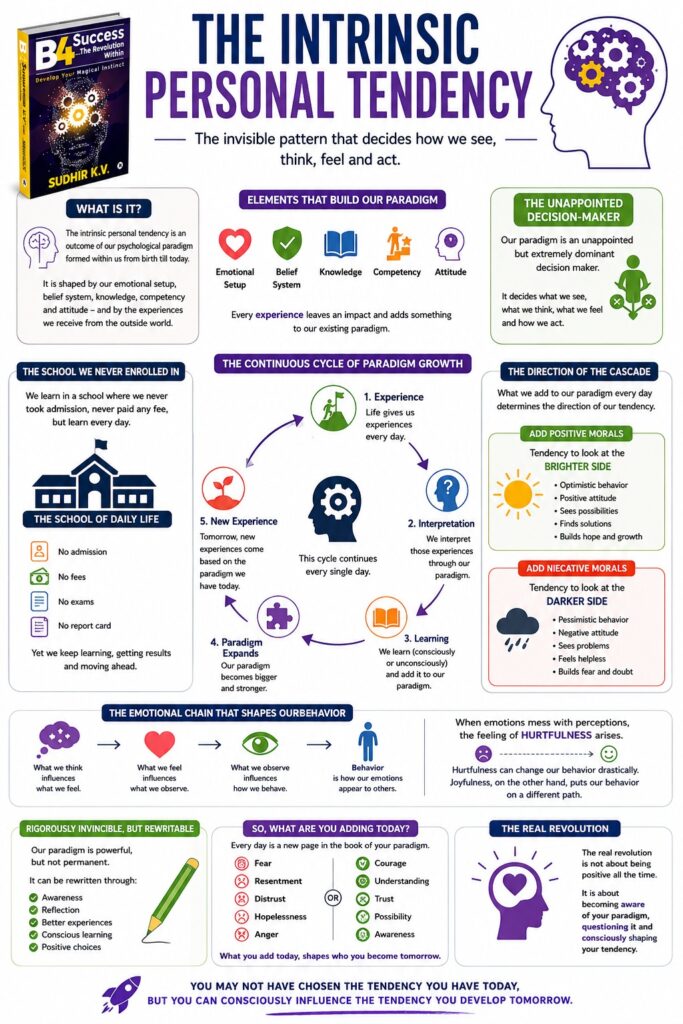
Our emotional setup, beliefs, knowledge, competency and attitude gradually become part of this inner framework.
Then life begins supplying the raw material.
Every experience leaves an impression.
A word spoken by a parent.
A teacher who encouraged you.
A friend who betrayed you.
A success that made you proud.
A failure that embarrassed you.
A relationship that gave you confidence.
Another relationship that broke your trust.
A moment when somebody believed in you.
A moment when somebody told you that you were not good enough.
Some experiences may appear insignificant at the time.
But the mind records them.
And each experience can add something to the psychological paradigm that is already forming within us.
That is why two people can live through similar situations and emerge with completely different perceptions of life.
The experience may be similar.
But the paradigm receiving the experience is different.
THE UNAPPOINTED DECISION-MAKER
Here is where the idea becomes truly interesting.
Your paradigm doesn’t need your permission to influence you.
It doesn’t announce:
“I am now going to influence your decision.”
It simply does it.
It quietly participates in deciding what you notice, what you interpret, what you feel and how you respond.
In that sense, it becomes an unappointed but extremely dominant decision-maker within us.
You see what your paradigm allows you to see.
You think what your paradigm allows you to think.
You feel what your paradigm allows you to feel.
And your actions are influenced by the conclusions that emerge from that internal framework.
Imagine two people receiving exactly the same feedback.
One hears:
“You have an opportunity to improve.”
The other hears:
“You are not good enough.”
The words may be identical.
But the internal experience can be completely different.
Why?
Because the words are entering two different paradigms.
And that paradigm influences the meaning we assign to the experience.
THE SCHOOL YOU NEVER ENROLLED IN
There is another fascinating metaphor in the original idea.
We spend our entire lives attending a school that we never consciously enrolled in.
We never filled out an admission form.
We never paid tuition fees.
We never selected the curriculum.
There are no classrooms.
No uniforms.
No annual examinations.
And yet, every single day, we learn.
Every single day, we are tested.
Every single day, we receive results.
There is no report card.
No teacher comes to tell us our marks.
Yet the consequences of our learning appear in the way we think, feel and behave.
What is this extraordinary school?
Daily life.
Life itself is our classroom.
Every conversation is a lesson.
Every relationship is a lesson.
Every success is a lesson.
Every failure is a lesson.
Every disappointment is a lesson.
Every joy is a lesson.
Every conflict is a lesson.
Every experience gives us an opportunity to add something to our existing paradigm.
And this is where the story becomes cyclical.
TODAY CREATES TOMORROW
Imagine that yesterday’s paradigm is like the soil in which today’s experiences are planted.
What we learn today gets added to what we already learned yesterday.
Then today’s expanded paradigm becomes the foundation from which we interpret tomorrow’s experiences.
Tomorrow adds something more.
Then the day after tomorrow adds something more.
And so it continues.
Experience → interpretation → learning → paradigm → new experience → new interpretation.
It becomes a continuous chain.
Our thoughts and beliefs don’t simply appear from nowhere.
They are cultivated over time.
And once a pattern becomes established, it can begin influencing what we notice in future experiences.
This is why the paradigm can become increasingly powerful.
It grows.
It accumulates.
It develops momentum.
And, like time, it does not simply stop because we are not paying attention to it.
THE DIRECTION OF THE CASCADE
Now imagine two people going through life.
The first person repeatedly absorbs positive lessons from experience.
A failure becomes a lesson.
A rejection becomes an opportunity to improve.
A mistake becomes feedback.
A difficult relationship teaches understanding.
A setback develops resilience.
Over time, these experiences can accumulate into a tendency to look for the brighter side of things.
The second person experiences the world differently.
A failure becomes proof of inadequacy.
A rejection becomes proof that nobody cares.
A mistake becomes evidence that everything will go wrong.
A difficult relationship becomes proof that people cannot be trusted.
A setback becomes confirmation that life is unfair.
Over time, those interpretations can accumulate too.
The person may gradually develop a tendency to look toward the darker side of things.
This is where the idea of intrinsic personal tendency becomes powerful.
It is not simply about whether someone is “positive” or “negative.”
It is about the direction in which their internal pattern has been developing.
One tendency naturally looks toward possibilities.
Another naturally looks toward obstacles.
One searches for light.
Another notices darkness first.
IS POSITIVITY ALWAYS POSSIBLE?
At first glance, the answer seems obvious.
Surely the tendency to see the brighter side of life is better.
Optimism sounds desirable.
Positive attitude sounds desirable.
Hope sounds desirable.
And certainly, there is value in cultivating such a tendency.
But there is a deeper question.
Can a human being remain positive in every situation?
That is the million-dollar question.
Because we are not machines.
We are emotional beings.
We love.
We laugh.
We fear.
We hate.
We cry.
We celebrate.
We grieve.
We hope.
We feel disappointed.
And these emotions don’t always disappear within seconds.
A feeling can stay with us for minutes.
Sometimes hours.
Sometimes days.
Sometimes months.
And sometimes, a powerful emotional experience can remain within us for years.
So perhaps the challenge isn’t simply:
“How can I become positive?”
Perhaps the deeper challenge is:
“How do my emotions influence the way I perceive reality?”
THE EMOTIONAL CHAIN
There is a fascinating chain hidden within our everyday behaviour:
What we think influences what we feel.
What we feel influences what we observe.
What we observe influences how we behave.
And once emotion becomes visible through our words, expressions and actions, other people experience it as our behaviour.
Think about the last time you were hurt.
Did you behave exactly as you would have behaved on your happiest day?
Probably not.
A person who is joyful may respond with patience.
The same person, when deeply hurt, may respond with anger.
The same intelligence.
The same knowledge.
The same person.
But a different emotional state.
And suddenly, the behaviour changes.
That is the behavioural roller coaster.
Our emotions can move our behaviour onto entirely different tracks.
WHEN EMOTIONS COLLIDE WITH PERCEPTION
This is where things become even more complicated.
We don’t simply feel emotions.
We interpret the world through them.
And when emotion interferes with perception, one of the most powerful feelings in our emotional dictionary can emerge:
Hurtfulness.
When we feel hurt, the world can suddenly look different.
A harmless comment may sound insulting.
A suggestion may sound like criticism.
Silence may feel like rejection.
A delay may feel like disrespect.
A disagreement may feel like betrayal.
The external event may be small.
But the emotional meaning attached to it can become enormous.
And once we feel hurt, our behaviour can change dramatically.
We may withdraw.
We may attack.
We may blame.
We may become defensive.
We may say things we later regret.
And sometimes, we may make important decisions while standing inside an emotional storm.
That is the danger.
THE REAL REVOLUTION
Perhaps the revolution within is not about forcing ourselves to be positive all the time.
It is not about pretending that pain doesn’t exist.
It is not about smiling when we are hurting.
It is not about denying anger, sadness, disappointment or fear.
The deeper revolution may be about becoming aware of the internal pattern that is influencing us.
To notice:
What am I seeing?
Why am I seeing it this way?
What am I feeling?
What created this feeling?
Is my interpretation the only possible interpretation?
Am I responding to what actually happened—or to what I believe happened?
That pause can be extraordinarily powerful.
Because between an experience and our response lies an opportunity.
An opportunity to observe our paradigm.
And once we can observe it, perhaps we can begin to question it.
THE BEAUTIFUL POSSIBILITY
The most hopeful idea in this entire concept is this:
The paradigm may be powerful, but it is not necessarily permanent.
It is described as rigorously invincible—but rewritable.
That changes everything.
If our intrinsic personal tendency were permanently fixed, there would be little point in self-discovery.
But if it can be rewritten, then our experiences don’t have to imprison us.
The past can influence us without permanently defining us.
A person who has learned to expect failure can learn to recognize possibility.
A person who has developed distrust can learn to examine trust differently.
A person who habitually sees darkness can learn to notice the white space around the black spot.
Not overnight.
Not by simply repeating positive sentences.
But through awareness, reflection, new experiences and conscious learning.
SO, WHAT ARE YOU ADDING TO YOUR PARADIGM TODAY?
This may be the most important question to carry with you after reading this chapter.
Every day, life is teaching you something.
The question is not whether you are learning.
You are.
The real question is:
What are you learning?
Are you adding fear?
Or courage?
Resentment?
Or understanding?
Distrust?
Or discernment?
Hopelessness?
Or possibility?
Anger?
Or awareness?
Every day becomes another page in the invisible book of your paradigm.
And tomorrow, you will read that book when you think, feel and act.
So perhaps we should become a little more careful about what we write into it.
Because the person you become tomorrow may be shaped by what you repeatedly allow yourself to learn today.
And somewhere within that continuous chain of experiences, thoughts, emotions and beliefs, an intrinsic personal tendency is quietly taking shape.
It may be teaching you to look for the light.
Or it may be training you to search for the darkness.
The fascinating part is this:
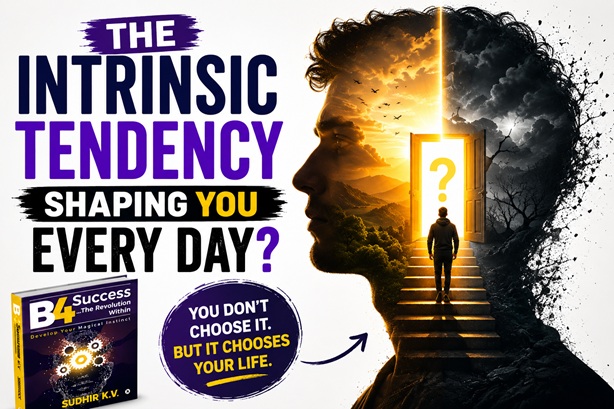
You may not have consciously chosen the tendency you have today.
But perhaps…
you can consciously influence the tendency you develop tomorrow.
And that is where the real revolution within begins.
Here is the visual summary