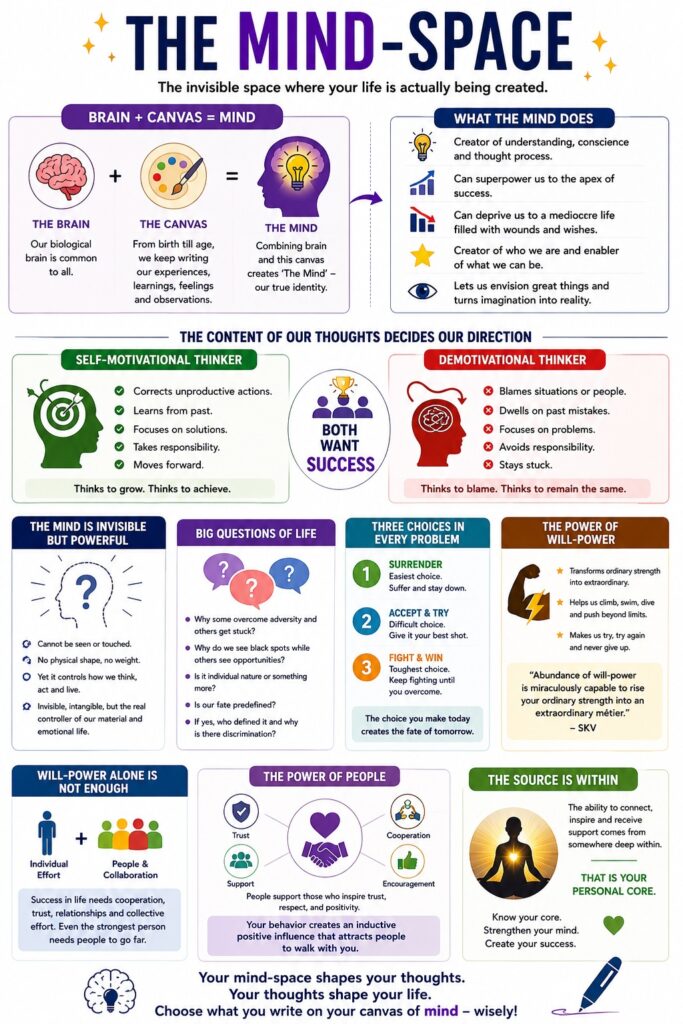
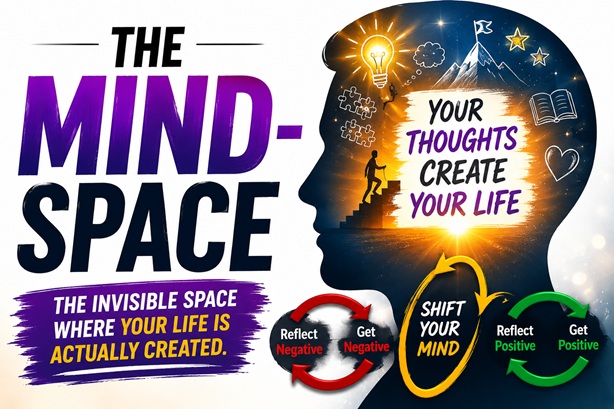
THE MIND-SPACE
The invisible space where your life is actually being created
We all carry a brain.
Biologically, it is remarkably similar from one human being to another.
It regulates our heartbeat.
Controls our reflexes.
Processes information.
Coordinates our body.
Keeps us alive.
But there is something fascinating about the human brain.
It doesn’t remain the same in its expression.
Some people use it to create extraordinary possibilities.
Others use the same biological machinery to repeatedly convince themselves that nothing will work.
Some see opportunity in difficulty.
Others see difficulty in almost every opportunity.
Some recover from failure and become stronger.
Others experience failure once and carry it for years.
So what makes the difference?
Perhaps the answer lies not merely in the brain…
but in the invisible space that develops around it.
The Mind-Space
Imagine that every human being is born with a magnificent, blank canvas.
From the very beginning of life, we start writing on it.
We write with experiences.
We write with emotions.
We write with observations.
We write with relationships.
We write with success and failure.
We write with praise and criticism.
We write with everything we learn—consciously and unconsciously.
Some marks are temporary.
Some become permanent.
And gradually, this enormous collection of experiences becomes our frame of reference—the internal reference system through which we begin interpreting the world.
Combine the biological brain with this constantly evolving canvas…
and something much more powerful emerges.
The Mind.
THE MIND CREATES THE MEANING
The brain processes.
But the mind gives meaning.
The same event can happen to two people and produce two entirely different internal realities.
A failure can mean:
“I am not capable.”
Or it can mean:
“I have discovered one way that doesn’t work.”
A rejection can mean:
“Nobody wants me.”
Or:
“This wasn’t the right opportunity.”
A difficult situation can become a reason to surrender…
or a reason to become stronger.
The event is outside us.
The meaning we create from the event happens inside us.
That is the extraordinary power of the mind-space.
THE MIND CAN SUPERPOWER YOU — OR LIMIT YOU
The mind has the ability to envision things that don’t yet exist.
Before a building is constructed, someone imagines it.
Before a company exists, someone imagines it.
Before an invention changes the world, someone imagines it.
Before a person achieves something extraordinary, there is often an invisible picture of that possibility inside the mind.
The mind can therefore become a tremendous source of power.
It can push an ordinary person toward extraordinary achievement.
But the same mind can also become a prison.
It can repeatedly remind you of your failures.
It can magnify your fears.
It can replay your wounds.
It can convince you that your limitations are permanent.
And slowly, the person begins living inside a reality created not by what is possible…
but by what the mind has learned to believe is possible.
That is the paradox.
The mind can become both your greatest superpower and your greatest limitation.
WHAT ARE YOU FEEDING YOUR MIND?
There is something even more intriguing.
We all know, at least intellectually, what we should think about.
Kindness.
Empathy.
Solutions.
Opportunities.
Joy.
Growth.
Success.
Yet how often does the mind voluntarily return to something else?
A past insult.
A future anxiety.
A potential risk.
A problem.
A failure.
A revenge fantasy.
A fear of what might happen.
We know that repeatedly thinking about such things may not help us.
And yet…
we keep thinking about them.
Why?
Because the mind doesn’t simply follow instructions from our conscious intentions.
It has already developed patterns.
And those patterns influence the content that repeatedly appears in our thoughts.
TWO PEOPLE. ONE GOAL. COMPLETELY DIFFERENT MIND-SPACES.
Consider two people who have both experienced failure.
The first thinks:
“I failed. What should I change?”
The second thinks:
“I failed. Whose fault was it?”
Both want success.
Both may have similar intelligence.
Both may have similar opportunities.
Both may work equally hard.
But their internal conversations are completely different.
The first person converts failure into self-correction.
The second converts failure into blame.
One asks:
“What can I do differently?”
The other asks:
“Who prevented me from succeeding?”
And slowly, these repeated thoughts begin producing different behaviours.
Different behaviours produce different experiences.
Different experiences reinforce the original beliefs.
And the cycle continues.
THE STRANGE INVISIBLE CONTROLLER
Now comes one of the biggest mysteries.
The mind cannot be seen.
You cannot place it on a weighing machine.
You cannot touch it.
You cannot hold it in your hand.
A surgeon cannot simply point to a physical object and say,
“There is your mind.”
And yet this invisible, intangible phenomenon can influence something as tangible as your life.
It influences how you interpret a conversation.
How you respond to criticism.
How you handle failure.
How you experience love.
How you respond to fear.
How you perceive opportunity.
How you treat people.
And ultimately…
how you live.
Isn’t that strange?
Something we cannot physically see can have such a powerful influence on everything we can see.
THEN WHO IS REALLY RUNNING YOUR LIFE?
This takes us into some uncomfortable questions.
Why does one person remain calm in a crisis while another collapses?
Why can one person see possibilities inside a difficult situation while another sees only problems?
Why does one person recover from adversity while another becomes permanently trapped inside it?
Why does one person naturally see the bright canvas while another keeps staring at the black spot?
Is it simply personality?
Is it individual nature?
If so, where did that nature come from?
And if every person wants success, why doesn’t every person naturally develop the mental patterns required to achieve it?
What defeats our desire?
What weakens our will?
What makes us surrender when we know we should fight?
These questions take us even deeper into the architecture of the mind.
WHAT ABOUT FATE?
And then comes perhaps one of humanity’s oldest questions:
Is our life already predetermined?
Some traditions and systems claim that the future can be predicted through calculations based on birth, time and place.
If that were entirely true, an intriguing contradiction appears.
If the mind is controlling our life…
how can something supposedly determined before the mind has even developed predict the future?
And if our future is already written, then what is the purpose of effort?
Why struggle?
Why learn?
Why change?
Why try to become better?
Would life simply be a giant coin toss whose result has already been decided?
But then comes the more powerful question:
What if you knew your future—and you didn’t like it?
Would you simply surrender?
Would you say,
“This is my fate. There is nothing I can do.”
Or would you fight?
Most of us already know the answer.
When we encounter something we don’t want, we naturally try to change it.
We reject the unwanted.
We search for something better.
We struggle.
We persist.
We fight against circumstances.
And that raises another fascinating question:
Where does that strength come from?
THE THREE CHOICES
Whenever life places a difficult problem in front of us, there are essentially three paths.
The easiest:
Surrender to the problem.
Accept defeat.
And suffer.
The difficult:
Accept the problem and make an attempt to overcome it.
The toughest:
Keep fighting until you overcome it.
The problem may be identical.
But the choice can be completely different.
And that choice can change the direction of a life.
So what decides which path we choose?
What is the invisible force inside us that says:
“Give up.”
or
“Try once more.”
or even:
“I don’t care how difficult this becomes. I will find a way.”
Perhaps one answer is:
WILL-POWER
“Abundance of will-power is miraculously capable to rise your ordinary strength into an extraordinary métier.”
— SKV
Will-power can make an ordinary person attempt extraordinary things.
It can make someone climb a mountain.
Swim against a powerful current.
Push beyond physical limitations.
Continue when others stop.
Try again after failure.
And try again.
And again.
That is why it is tempting to conclude:
If I have enough will-power, I can achieve anything.
But there is a catch.
WILL-POWER ALONE IS NOT ENOUGH
Imagine the most determined person in the world.
Someone with extraordinary discipline.
Exceptional focus.
Unbreakable persistence.
Can that person succeed at everything?
Not necessarily.
Why?
Because not every success is an individual performance.
Some achievements require people.
A brilliant student may achieve the highest marks in a university.
But that does not automatically guarantee success in professional life.
Someone may be extraordinarily capable at their work and still struggle to maintain relationships.
Someone may be fiercely ambitious and still fail to build trust.
Someone may have tremendous individual performance and yet struggle in a social environment.
Why?
Because human beings don’t live in isolation.
Success is often collective.
We need cooperation.
We need relationships.
We need trust.
We need emotional support.
We need people who believe in us.
We need people who are willing to stand beside us when things become difficult.
And sometimes, the person who succeeds is not the person who can do everything alone…
but the person who can inspire others to contribute willingly.
THE POWER OF PEOPLE
Think about the biggest achievements in your own life.
How many of them happened entirely because of you?
Someone probably taught you something.
Someone encouraged you.
Someone opened a door.
Someone gave you an opportunity.
Someone supported you when you doubted yourself.
Someone stood beside you during a difficult moment.
Even the strongest individual eventually discovers a simple truth:
We cannot go very far without people.
So the question changes.
It is no longer simply:
“How strong is my will-power?”
It becomes:
“How do I create the kind of positive influence that makes people genuinely want to support me?”
Not because they are forced.
Not because they are obligated.
Not because they expect something in return.
But because they want to.
That is a very different kind of power.
THE INDUCTIVE POSITIVE INFLUENCE
Imagine meeting someone whose presence naturally makes you feel better.
Someone who listens.
Someone who respects.
Someone who encourages.
Someone who doesn’t constantly compete.
Someone who gives confidence rather than insecurity.
Someone whose behaviour makes you want to contribute.
You don’t help such a person because you have to.
You help because you genuinely want to.
That is the kind of positive influence the chapter points toward—an inductive-positive-influence emerging from within a person’s behaviour.
And now we arrive at the most intriguing part.
Where does this influence come from?
Where does that ability to connect with people originate?
Why do some people naturally attract cooperation while others repeatedly create resistance?
Why do some people inspire trust?
Why do some people make others want to walk with them?
Why do some people receive support even when they ask for nothing?
The answer, according to this journey, is not somewhere outside.
It is not in money.
It is not in status.
It is not merely in intelligence.
It is not even in will-power alone.
The source is somewhere deep within us.
It lies in our personal core.
And perhaps this is where the story becomes even more fascinating.
Because if the mind-space shapes our thoughts…
and our thoughts shape our behaviour…
and our behaviour influences the people around us…
then understanding the personal core may be the key to understanding something much bigger:
Who we are.
What we can become.
And why some people are able to transform their inner strength into extraordinary success.
The real journey is only beginning.
Here is the visual summary